A certificate gets you noticed, but skills get you hired. You need to know the difference before you enroll in anything.
This article is about what employers are looking for, the role of certificates, the areas in which certificates are lacking, and the things that a good digital marketing course should provide you with, even if you don’t have a certificate at the end.
| Quick Summary: Skills and certificates are both important in digital marketing, albeit for different reasons. When you finish training, a certificate indicates it. Skills demonstrate that you can do the job. Employers want to fill positions with skills. Certificates are the ticket to the interview! |
Proven capability is more valued by employers than theoretical knowledge. They need someone who can help from the start.
This is not to say that certificates are worthless. Google or HubSpot certifications are sought after by many job postings, particularly lower-level positions. But those certificates have value, as they are linked to actual platform knowledge.
| Definition: A certificate is a document that affirms completion of a course or assessment. A skill is what you learned and amply demonstrated in real-life situations, with stress and real consequences. |
Let’s say after the same Google Analytics 4 course, 2 people finish. One reads the modules, passes the quiz, and continues on. The other installs GA4 on a real site, observes actual events, links with Google Ads, and uses the data to tweak a Google Ads campaign.
Both of them possess the certificate. There’s one that’s skilled.
Yes, but…
Some employers will take recognized certifications seriously. Google’s Digital Marketing & E-commerce Certificate is on the must-have list in entry-level job postings. Any paid search position is virtually a requirement to be Google Ads certified. HubSpot certificates are respected in the position of inbound marketing and content.
It’s the word recognised that’s important. When a certificate is issued by a reputable site or organisation, it indicates that the training has a standard. A certificate from an unknown provider, which was earned in 3 hours, conveys practically nothing.
A certificate opens the door to the interview. What you can demonstrate in the interview determines whether you walk through it.
A course worth your time and money will cover more than theory. These are the skills that can be used immediately in the workplace:
The distinction between a course that teaches these skills and one that does not is that some offer practice on actual accounts. Tips on keyword research won’t be the same as doing keyword research on a live site. Creating a Google AdWords campaign in a sandbox is different than running a Google Ads campaign with real money.
This is a fair concern, and it’s one of the honest downsides of any certification.
Platforms change. Google updates its Ads interface regularly. Meta restructures its ad account options. A certification earned two years ago may not cover tools and strategies that are standard today. LinkedIn Learning’s 2024 research found that 70 percent of marketers feel their digital skills become outdated within three years.
Skills, however, transfer. These skills are applicable across all platforms and tools: understanding how to analyse data, structure a campaign, write copy which converts, or diagnose why a site lost organic traffic: these skills work no matter what platform or tool changes around them.
So what is the key benefit that any digital marketing course can offer you is the approach or mindset rather than the tool. The way the steps will change is going to change.
Before signing up at any place, you should ask the following questions:
The course that fulfills these requirements is good value for your money.
InterSmart EduTech is a leading digital marketing institute in Kochi built around one idea: training that produces marketers who can do the job, not just pass an exam.
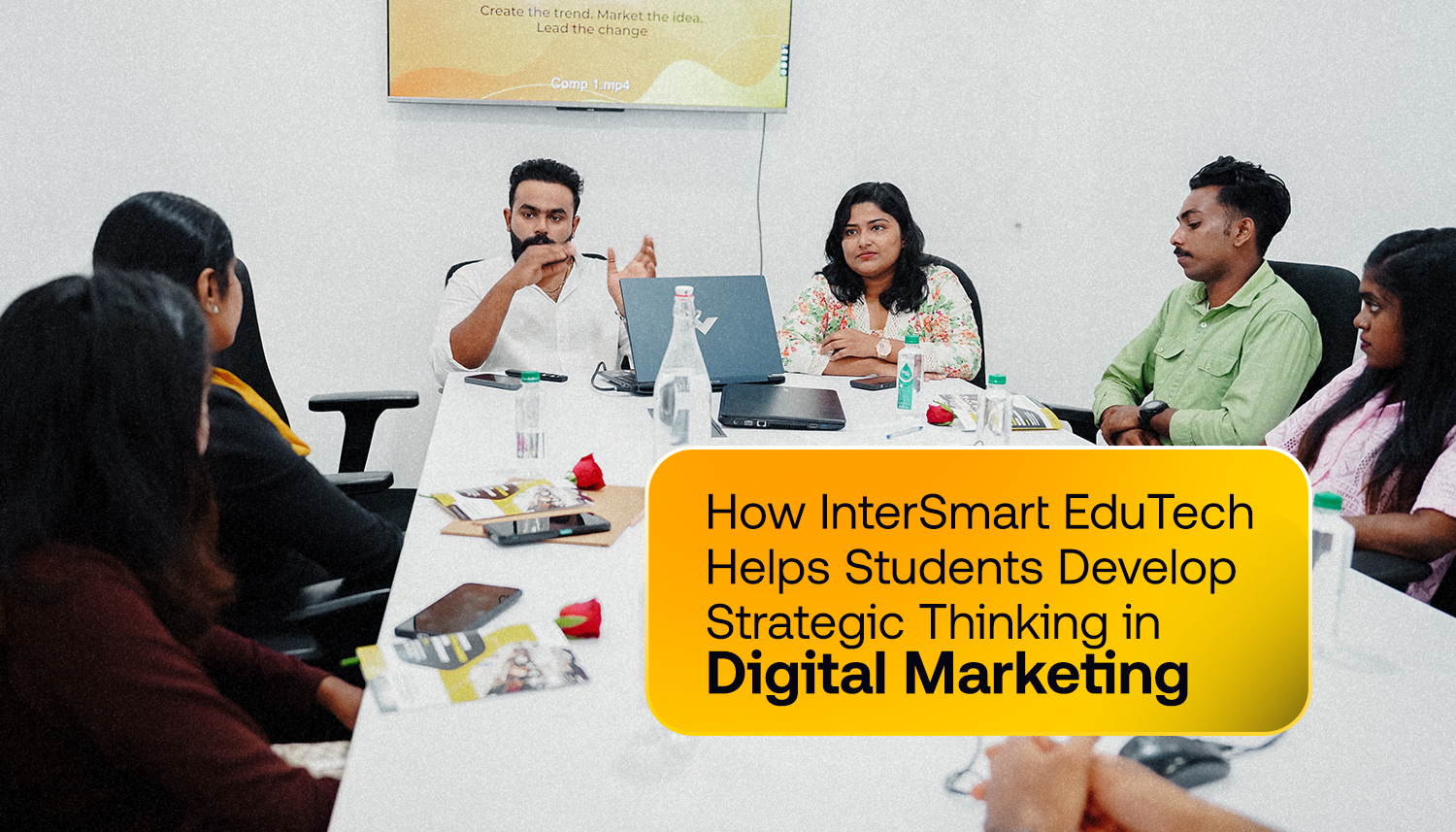
Every module at InterSmart EduTech is taught by practitioners who use these tools on live client accounts. SEO is learned by actually optimising pages. Google Ads is learned by building and running campaigns. GA4 is learned by setting up tracking on live websites and interpreting the data it collects.
Students leave with a portfolio of real work, not a folder of screenshots from a course. That portfolio is what makes the difference in an interview.
As one of the most trusted digital marketing institutes in Kerala, InterSmart EduTech also provides placement support, so the skills you build have a direct path to employment. Certificates are part of the program. But they’re the outcome of real learning, not a shortcut around it.
If you’re weighing up digital marketing courses and want to know what makes InterSmart EduTech different, get in touch. The conversation starts with your goals, not a sales pitch.